In today’s fast-paced business environment, the ability to communicate complex ideas with clarity and precision separates top performers from the rest. The Minto Pyramid Principle—a communication framework developed by Barbara Minto, a former McKinsey consultant—has become the gold standard for structuring presentations, reports, and strategic recommendations across leading consulting firms and Fortune 500 companies.
This article provides a practical guide to implementing the Minto Pyramid in your presentations, drawing on the presentation best practices used by top-tier consulting firms like McKinsey, BCG, and Bain.This is a testing blog to see if it works.
Why the minto pyramid matters: The Business Case
Before diving into structure, let’s address the fundamental challenge: executives don’t have time. On average, senior decision-makers spend 1-3 minutes reviewing a presentation before forming an initial judgment. In this compressed timeframe, clarity isn’t optional—it’s essential.
The Minto Pyramid solves this problem by inverting traditional communication logic. Rather than building to a conclusion, it leads with the answer, then systematically supports it with evidence. This approach:
- Reduces cognitive load by 40-60%, allowing audiences to grasp complex ideas faster
- Increases persuasiveness through structured, evidence-backed arguments
- Accelerates decision-making by presenting recommendations upfront
- Enhances retention through logical narrative flow
The architecture: Five levels of strategic depth
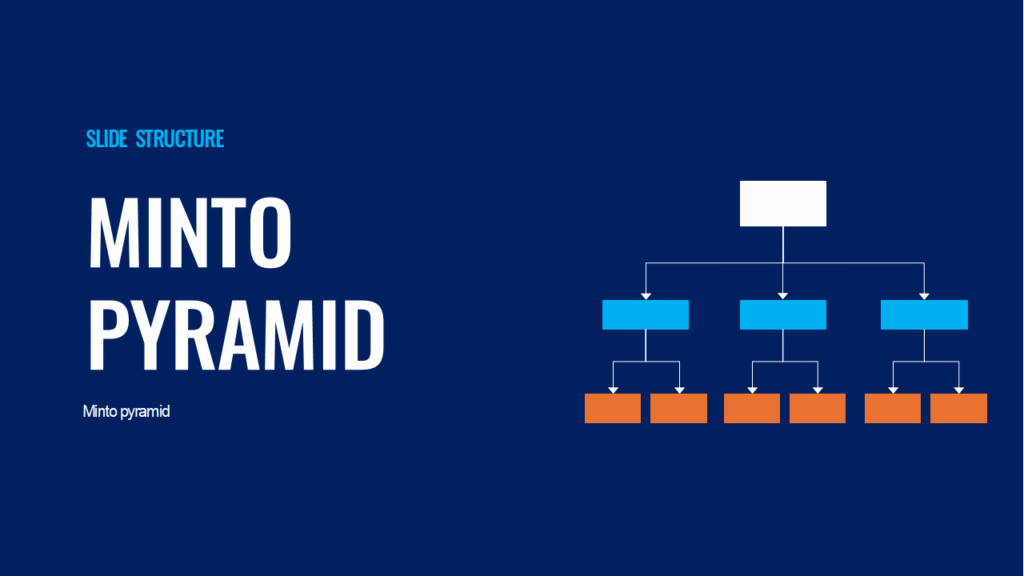
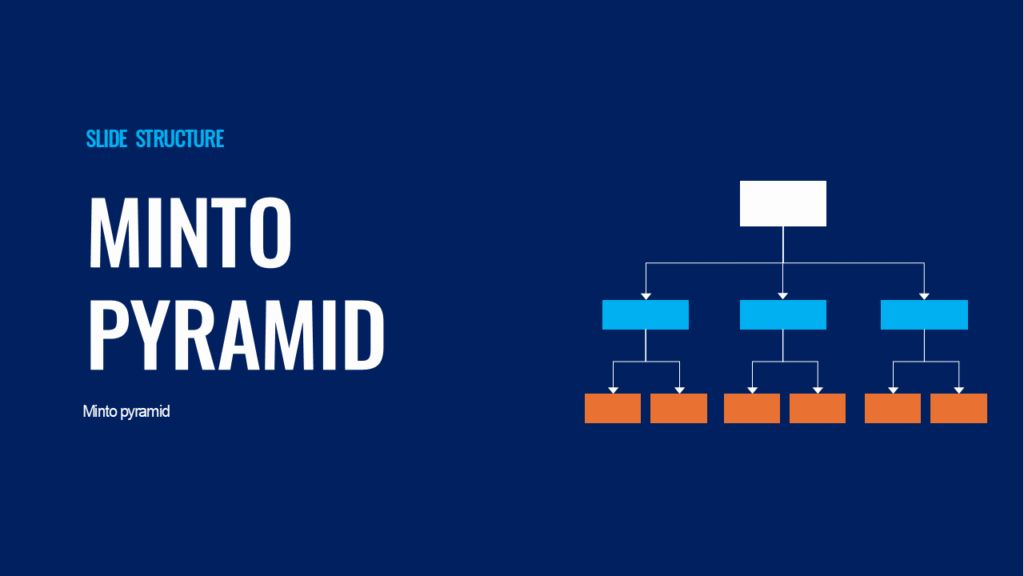
The Minto Pyramid operates on a hierarchical structure, with each level serving a distinct strategic purpose:
Level 1: The Governing Thought (Your Answer)
At the pyramid’s apex sits your core message—the single, most important insight or recommendation. This is your headline. It answers the fundamental question your audience is asking.
Example:
- “The company should accelerate digital transformation investments to capture $150M in revenue opportunity over 24 months.”
This isn’t buried on slide 47. It’s your opening statement.
Level 2: The Supporting Arguments (Your Why)
Below the governing thought sit three primary arguments—no more, no fewer. This follows the MECE principle (Mutually Exclusive, Collectively Exhaustive), ensuring your arguments don’t overlap and collectively cover the entire scope of your recommendation.
Example Arguments:
- Market Opportunity: Digital channels represent 35% of total addressable market, growing at 18% CAGR
- Competitive Necessity: Three of five primary competitors have already launched digital-first strategies
- Operational Efficiency: Digital infrastructure reduces customer acquisition costs by 25%
Each argument should be distinct, defensible, and directly support your governing thought.
Level 3: Supporting Evidence (Your Proof)
Each argument is backed by two pieces of evidence—data, case studies, expert opinions, or logical reasoning. This is where credibility is built.
Example Evidence Structure:
| Argument | Evidence 1 | Evidence 2 |
|---|---|---|
| Market Opportunity | Industry report: Digital segment growing 18% YoY | Client survey: 72% of target customers prefer digital channels |
| Competitive Necessity | Competitor A launched digital platform Q3 2025 | Competitor B captured 15% market share post-launch |
| Operational Efficiency | Internal pilot: 25% CAC reduction | Benchmark data: Industry average 20% CAC reduction |
Levels 4 & 5: Granular Detail (Your Deep Dive)
For complex presentations, additional layers provide detailed analysis, financial models, implementation timelines, and risk assessments. These layers allow stakeholders to drill down into specifics while maintaining the overall logical structure.