
If you’ve ever sat through a presentation where the charts were “interesting” but the point wasn’t clear, you’ve experienced one of the most common slide-deck problems: the slides describe information, but they don’t communicate a takeaway.
A simple technique used in top consulting firms (think McKinsey and Bain-style decks) solves this quickly: action titles.
In this article, you’ll learn what an action title is, why it’s so effective, and how to write action titles that make your PowerPoint or Google Slides deck instantly easier to understand, especially for executives and busy stakeholders.
A. What are Action Titles?
An action title is a slide title that states the key conclusion of the slide—the “so what?”—instead of just describing the content.
Most slides use descriptive titles like: “Industry segment by annual turnover and growth rate”. That tells your audience what they’re looking at, but not what it means.
An action title turns the title into a clear message, like: “Hospitals are the largest and fastest-growing healthcare segment”. Now the reader understands the takeaway immediately, and the chart becomes supporting evidence rather than a puzzle.
In short: action titles are message-driven slide headlines.
B. Why Action Titles improve presentations (Especially for executives)
Action titles work because they align with how people actually consume slides: quickly, selectively, and often under time pressure.
1) Action titles save time for busy audiences
Executives rarely study charts line-by-line. They scan for the headline. A strong action title gives them the main point up front, so they don’t have to interpret the data themselves.
2) Action titles reduce misinterpretation
When the slide doesn’t state the conclusion, different people can walk away with different interpretations. Action titles prevent confusion by explicitly stating the intended insight.
3) Action titles make your deck tell a story
If every slide title is a takeaway, your deck becomes readable as a narrative. Someone should be able to skim slide titles alone and still understand the storyline.
C. Three patterns used by top-tier management consultant for Action Titles
Pattern 1: Outcome + magnitude + timeframe (the “executive headline”)
What this pattern is :
This is the most classic consulting-style action title. It reads like a mini conclusion you could lift straight into an email subject line. The title answers three executive questions immediately:
- What happened / what will happen? (Outcome)
- How big is it? (Magnitude)
- By when / over what period? (Timeframe)
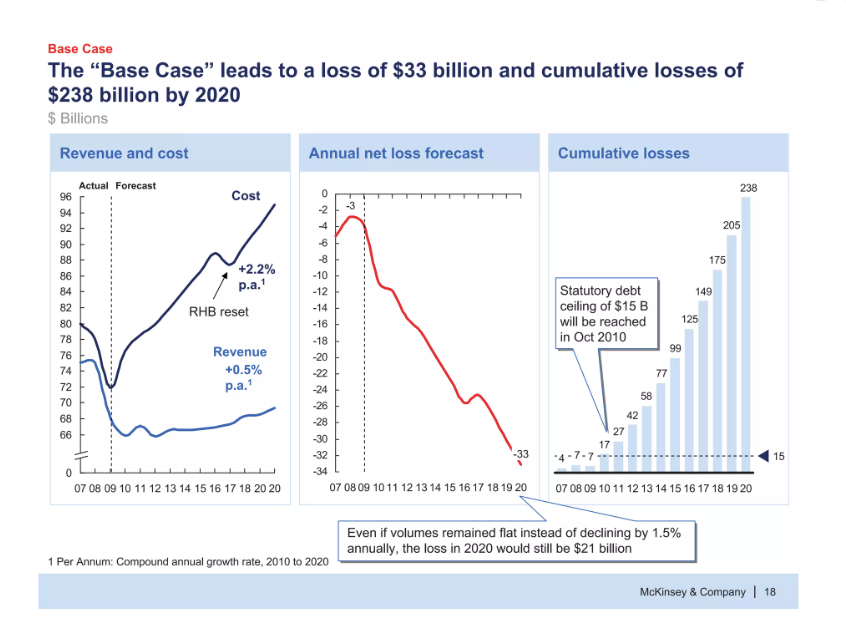
Example (McKinsey): “Base Case leads to a loss of $33 billion and cumulative losses of $238 billion by 2020.”
How to “read” it like the presenter does:
- “Base Case” = sets the frame/assumptions. This prevents ambiguity (it’s not all cases, it’s this scenario).
- “leads to a loss” = the directional takeaway (negative). No one has to interpret the chart trend first.
- “$33B” and “$238B cumulative” = quantifies two different but complementary ideas:
- an immediate/point loss (often annual or period loss), and
- a bigger cumulative impact (total over time).
- “by 2020” = makes it decision-relevant. Without time, the number is less actionable.
Why it’s powerful:
Even if the slide body has multiple charts, the title synthesizes them into one statement. The audience can now use the visuals to validate details rather than hunt for the point.
Template you can copy:
- “Scenario/segment” results in outcome of “number” and “cumulative/secondary number” by “date”
- “Option A” delivers “impact” of “X” over “timeframe” vs “OptionB”
Pattern 2: Key metric + insight that isn’t obvious at first glance (the “hidden punchline”)
What this pattern is:
This pattern combines:
- a headline metric everyone expects (size, revenue, spend, users), and
- an interpretation that many viewers won’t immediately extract from the chart (a split, concentration, location, driver, surprising proportion).
It’s common in consulting because the value isn’t “here is data,” it’s “here is what matters inside the data.”
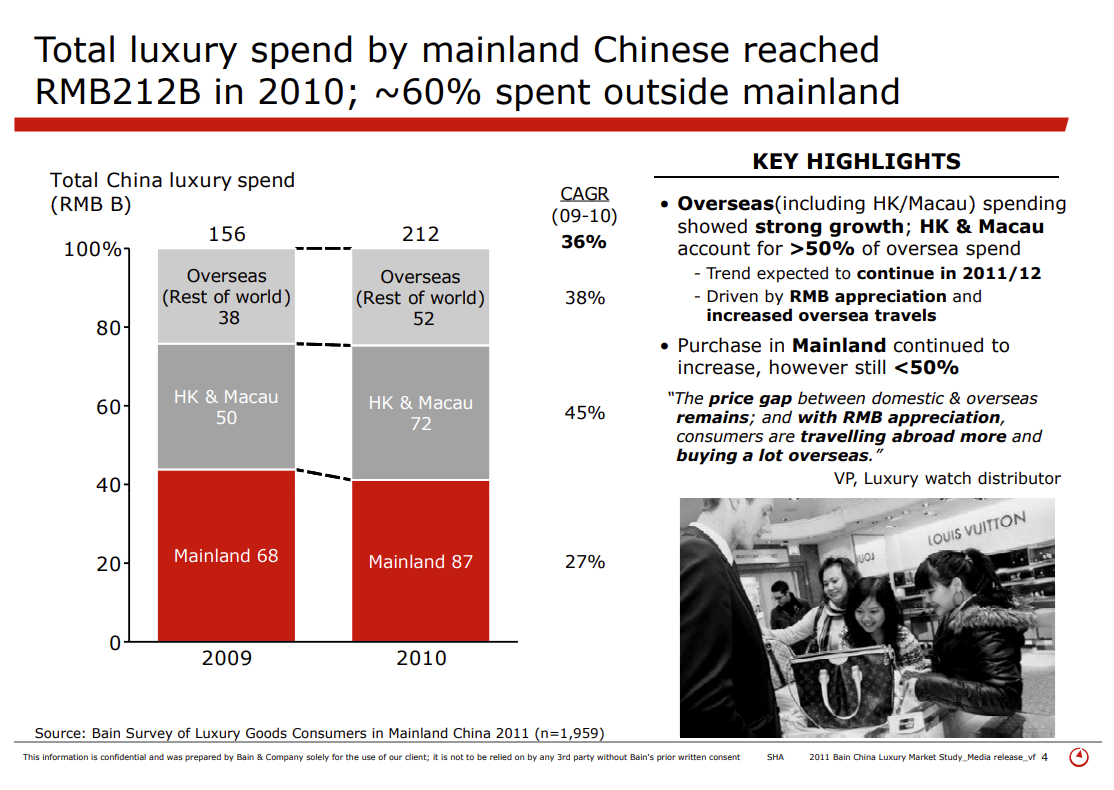
Example (Bain): “Total luxury spend by mainland Chinese reached RMB212B in 2010; ~60% spent outside mainland.”
How to “read” it like the presenter does:
- First clause: sets context fast
- Who: mainland Chinese
- What: luxury spend
- How much: RMB212B
- When: 2010
- Second clause: adds the non-obvious implication
- “~60% outside mainland” is the strategic insight—it changes where you’d focus distribution, marketing, partnerships, store presence, travel retail, etc.
Why it’s powerful:
A chart might show bars or regions, but the audience may not do the math or may miss the key split. The action title does the thinking and makes sure everyone walks away with the same takeaway.
Template you can copy:
- “Keymetric” reached “value” in “year”; “surprising share/driver” accounts for “X”
- “Total” is “value”, but subset drives “X” of “growth/volume/profit”
Pattern 3: Descriptive vs action title contrast (topic label vs implication)
What this pattern is:
This is less a “title formula” and more a teaching pattern the video uses to show the difference between:
- a title that names the topic, and
- a title that states the meaning.
A descriptive title is often neutral and safe. An action title is a claim (backed by the slide).
Example (Oliver Wyman):
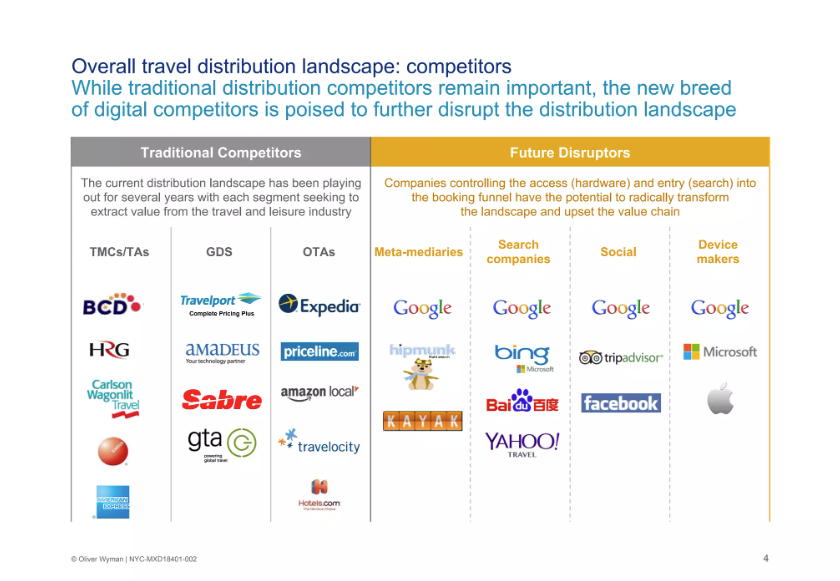
- Descriptive/title label: “Overall travel distribution landscape: online penetration and market value”
- Action/implication message: “The industry could reach the level of complete disruption in the next 10 years as new digital competitors enter the landscape.”
How to “read” it like the presenter does:
- The descriptive title tells you what variables exist (penetration, market value), but it doesn’t tell you why you should care.
- The action message provides:
- implication: “complete disruption”
- time horizon: “next 10 years”
- cause/driver: “new digital competitors”
This is exactly the “so what?” the descriptive title lacks.
D. Three principles for writing effective action titles
You don’t need a consulting background to write action titles. You just need a consistent method. These three principles mirror the video’s guidance.
1) Focus on the “so what” (never just describe)
Before you write the title, ask:
- What is the single most important takeaway here?
- What decision does this support?
- What would I say if I had to explain this slide in one sentence?
Your title should answer that, directly.
2) Be specific and narrow (and stay within what the slide proves)
A common mistake is making the title too broad or too ambitious.
Good action titles are:
- supported by the slide body
- specific (numbers, segments, comparisons, time periods)
- limited to what the evidence actually shows
If the slide shows 2024 data, don’t title it like a 10-year prediction, unless the slide truly supports that claim.
3) Use as few words as possible
Great action titles are short, sharp, and easy to scan.
A practical approach:
- write the first draft (it will be too long)
- remove filler words (“analysis shows,” “it can be seen that,” “in order to”)
- keep the strongest nouns and verbs
- aim for punchy and clear
E. Conclusion
Action titles are one of the fastest ways to upgrade your presentations. They make your deck clearer, more persuasive, and easier for busy audiences to follow.
If you want to apply this immediately, try this quick exercise: skim your deck in “slide sorter” view and read only the titles. If the story doesn’t make sense from titles alone, rewriting them as action titles will dramatically improve the deck.
If you share one slide title and what the chart shows, I can rewrite it into 5 action-title options (short, medium, and “consulting-style”).